
Counting assets is not the same thing as diversification.
Owning more assets does not automatically make a portfolio more diversified.
If those assets all respond to the same risks, they can behave like one large position.
That is why correlation matters.
What correlation tells you
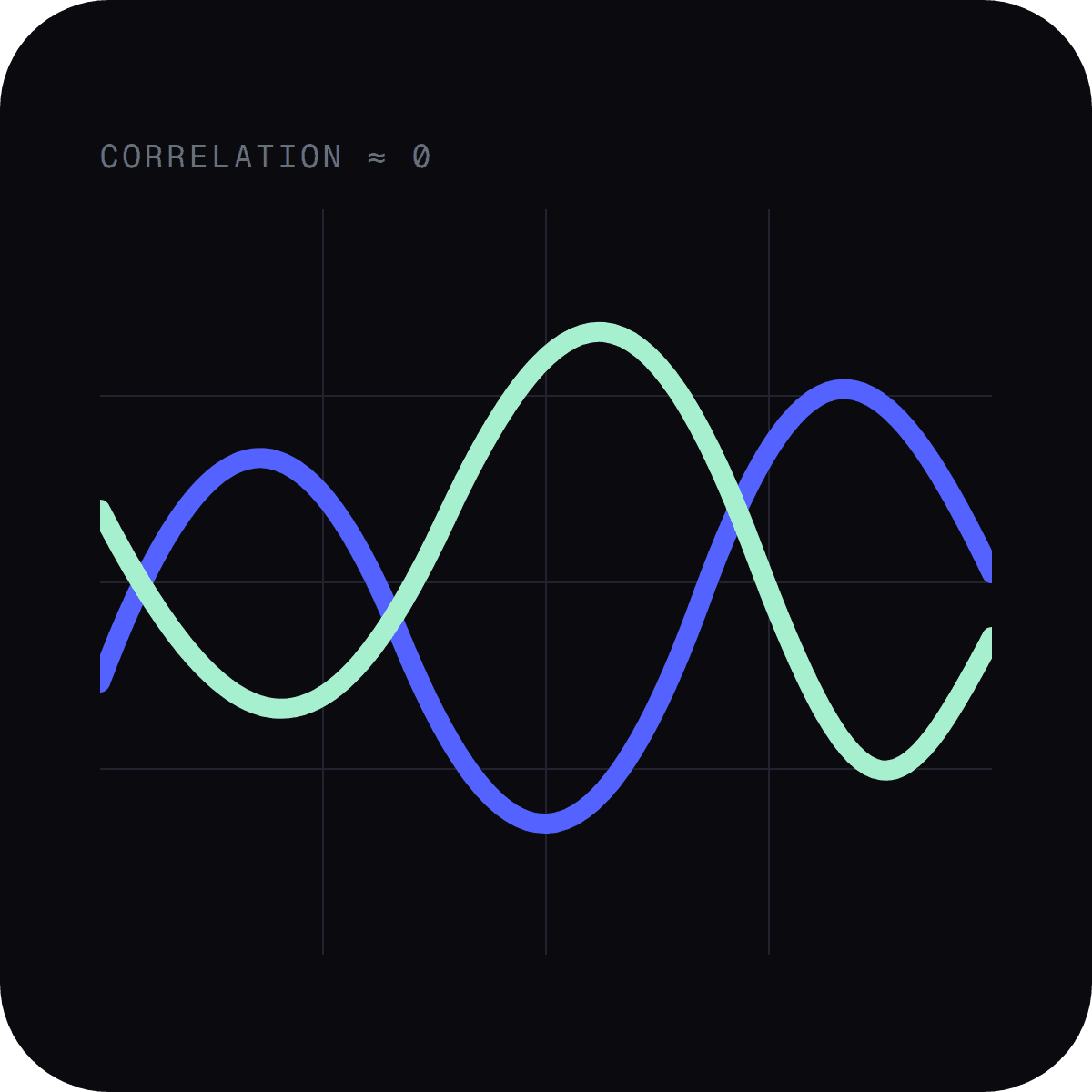
Correlation measures how two assets have moved relative to each other over a given period.
A high positive correlation means they have tended to move in the same direction.
A lower correlation means their returns have been less synchronized.
A negative correlation means they have tended to move in opposite directions.
That relationship affects the behavior of the combined portfolio.
Why the combination matters
Suppose you own two volatile assets.
If they usually move together, a bad day for one may also be a bad day for the other.
You have two positions, but not necessarily much diversification.
Now suppose the two assets respond to different economic conditions.
One may fall while the other holds up or rises.
The portfolio can therefore be less volatile than either asset considered in isolation.
This is one of the central ideas in Modern Portfolio Theory.
Correlation is not permanent
Historical correlation is useful, but it is not a contract.
Markets can become more correlated during stress.
Assets that looked independent in normal conditions can suddenly react to the same source of liquidity, rates, or risk appetite.
This is especially important when evaluating newer or more complex onchain products.
A product can appear diversified because it contains several assets or strategies while still having concentrated exposure to the same underlying risk.
Look through the wrapper
The better question is not:
“How many assets are inside?”
It is:
“What are the actual sources of risk and return?”
Two strategies built on different tokens may still depend on the same market.
Two strategies with different names may still have the same liquidity risk.
Two assets with different price histories may still sell off together when the same source of leverage unwinds.
The wrapper is less important than the underlying exposures.
What this means in practice
When comparing yield strategies, look at:
What generates the return
What drives the losses
How liquid the underlying assets are
Whether the strategies depend on the same market
How the positions behave under stress
The goal is not maximum variety.
The goal is a portfolio whose risks are actually different.
Why this matters for Radial
Radial’s approach starts from portfolio construction rather than assuming the highest-yielding individual strategy is automatically the best place for capital.
Different strategies can serve different roles.
The important question is how they work together.
That is what makes diversification useful in the first place.


Keep reading.
Protocol updates, attestations and new articles. Follow Radial on X and LinkedIn.

